The Awakening Decade: Why Erotic Life Often Reaches Its Fullest Expression After 40
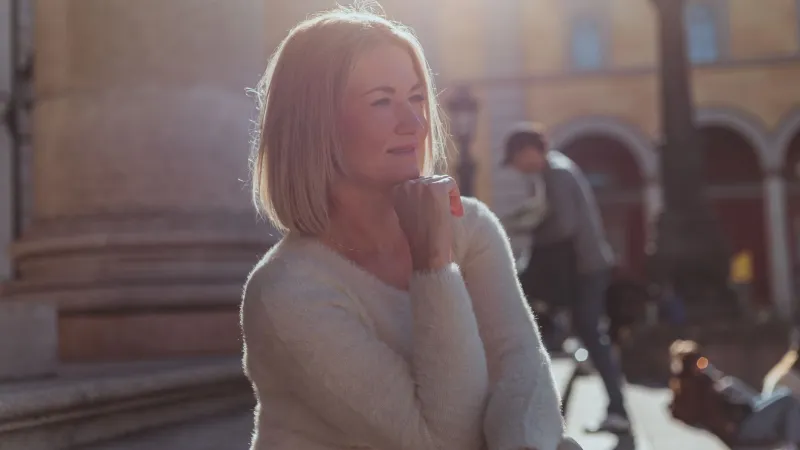
American culture has an almost pathological fixation on youth as the apex of sexual experience. The imagery that saturates mainstream adult content, the language used in lifestyle media, the implicit and explicit messages absorbed over decades of cultural consumption — all of it converges on a single, reductive premise: that desire peaks early and declines from there.
This premise is, for a great many people, demonstrably false.
Across the country, women and others in their forties, fifties, and sixties are experiencing something that the prevailing narrative has no adequate vocabulary for: not the fading of desire, but its deepening. Not the end of an erotic story, but what may prove to be its most compelling chapter.
At Mistress Elle Qui, we are committed to honoring the full arc of adult sexuality — including, and perhaps especially, the parts that mainstream discourse prefers to ignore.
What Biology Actually Tells Us
The conventional account of midlife sexuality, particularly for women, is dominated by a single narrative: hormonal decline, diminished libido, the body becoming an obstacle rather than an instrument of pleasure. This account is incomplete at best and misleading at worst.
While it is accurate that perimenopause and menopause involve hormonal transitions that can affect sexual response, the relationship between those transitions and actual erotic experience is considerably more complex than the decline narrative suggests. Research published in journals including Menopause and the Journal of Sexual Medicine has found that a substantial proportion of women report increased sexual satisfaction in midlife — not despite hormonal changes, but in some cases because of the psychological and relational shifts that accompany them.
Testosterone, often underappreciated in conversations about female sexuality, does not necessarily decline sharply in the forties for many women, and for some, the reduction in estrogen's moderating effects can actually heighten sensitivity to desire. More significantly, the biological changes of midlife frequently coincide with the elimination of concerns — pregnancy risk chief among them — that had previously occupied significant cognitive and emotional space during intimate encounters.
The body at forty, fifty, or sixty is not the body at twenty-two. It is, in many respects, a more knowledgeable one.
The Confidence Variable
If biology tells a more nuanced story than popular culture allows, the psychological dimensions of midlife sexuality are even more striking.
Self-knowledge accumulates. This is not a platitude — it is a measurable shift in the architecture of intimate experience. By the time most people reach their mid-forties, they have had sufficient experience with their own desires, their own bodies, and their own patterns to possess something that no amount of youth or physical vitality can substitute for: clarity.
They know what they want. They know what they do not want. They have, in many cases, developed the language and the confidence to communicate both.
Sociologist and researcher Pepper Schwartz, whose work on adult sexuality has been influential in reframing midlife desire, has noted that the forties and fifties frequently represent a period of what she describes as "erotic autobiography" — a conscious, often deliberate process of reassessing one's intimate life and making choices that are genuinely self-determined rather than shaped by the social pressures of earlier decades.
For women in particular, the reduction of certain social pressures — the pressure to be perpetually desirable by a narrow cultural standard, the pressure to prioritize a partner's pleasure above their own, the pressure to conform to relationship structures that may never have suited them — can function as an unexpected liberation.
Real People, Real Reckonings
The statistics and the sociological frameworks become most vivid when they are inhabited by actual experience.
Patricia, 52, a nurse practitioner in Portland, Oregon, describes her forties as the decade in which she finally understood what she had been gesturing toward in her sexual life for thirty years. "In my twenties and thirties, I had plenty of sex, but I was always slightly outside of it — watching myself, monitoring how I was being perceived, performing desire more than experiencing it," she says. "Somewhere around forty-four, that stopped. I genuinely stopped caring whether I looked a certain way or sounded a certain way. And what replaced that self-consciousness was something I can only describe as actual presence. The pleasure I've experienced in the last eight years has been more real than anything that came before it."
Renee, 61, a writer and educator based in New Orleans, had a different but equally striking trajectory. Her fifties, she explains, were marked by the end of a long marriage and what she initially feared would be the end of her intimate life. "I had been with the same person for twenty-two years. The idea of being sexual with someone new at fifty-six felt impossible and also, honestly, terrifying." What she discovered instead was a recalibration of her entire relationship to desire. "I had no template for who I was supposed to be sexually at this age, and that turned out to be the gift. I got to decide entirely from scratch. I explored things I had been curious about for decades. I set terms I had never felt entitled to set. It was the most genuinely free I have ever felt in an intimate context."
Jamila, 47, living in Atlanta, frames her experience in terms of reciprocity. "I used to accept whatever dynamic a partner established, because I didn't fully trust that my preferences were legitimate or interesting," she reflects. "Now I walk into every intimate situation knowing exactly what I bring to it and exactly what I require from it. That confidence — and I think it's really confidence more than anything else — has made me a better lover and has attracted better lovers to me."
Rewriting the Cultural Script
The adult content industry, for all its breadth, has been historically poor at representing midlife sexuality with any genuine sophistication. The dominant imagery skews relentlessly young, and when older adults appear, they are frequently framed through a lens of novelty or condescension rather than genuine erotic authority.
This is a failure of imagination as much as it is a failure of representation.
The consumers of adult content are not uniformly young. A significant and growing segment of the audience for premium lifestyle and intimacy platforms in the United States is composed of adults in their forties, fifties, and beyond — people who are not looking for content that ignores their existence, but for content that speaks to the particular texture of their desires with intelligence and respect.
Mistress Elle Qui exists, in part, to address precisely this gap. Power, pleasure, and unapologetic desire do not expire. They evolve. And for many people, their most sophisticated expression arrives later than anyone told them to expect.
An Invitation to Arrive
If you are in your forties, fifties, or sixties and you have absorbed the cultural message that your most vital erotic years are behind you, consider the possibility that this message was never about you. It was about a market that profits from insecurity and a cultural imagination too narrow to hold the full range of adult experience.
The evidence — biological, psychological, and deeply personal — suggests something far more interesting: that the intimate life you have been slowly, sometimes painfully, building the self-knowledge to inhabit may only now be becoming available to you.
That is not consolation. That is an invitation.
Arrive.